

Tubular Daylighting System: Energy Savings, Lifespan & Installation | BANFU
Tubular Daylighting Systems: What You Save, How Long It Lasts, and How It Gets Installed
Daytime lighting is one of the few operating costs a building can cut without changing how anyone works. A tubular daylighting system does not generate electricity and does not store it. It does one job: it captures daylight above the roof and delivers it, along a designed path, to the space below.
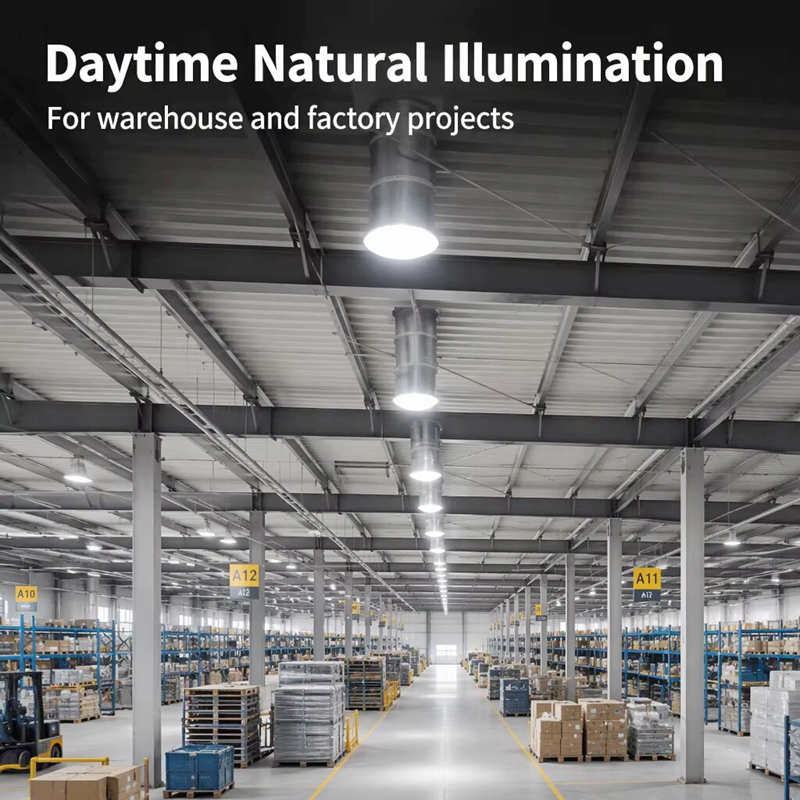
For factories, underground garages and large venues, lighting during working hours is a permanent line on the utility bill. Natural daylighting gives back part of that line — but only if the system is sized and installed for the actual building.
The three questions below are the ones buyers ask us most often, and the three that decide whether this system fits your project.
1. Energy savings: you are replacing daytime hours, not lamp wattage
Where the savings come from
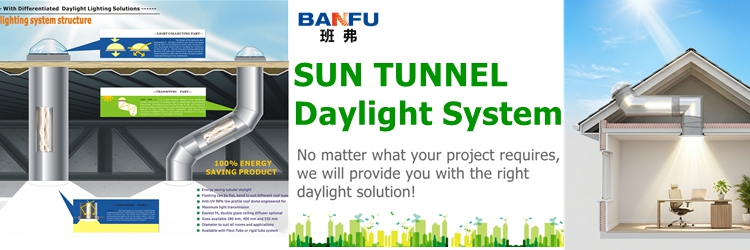
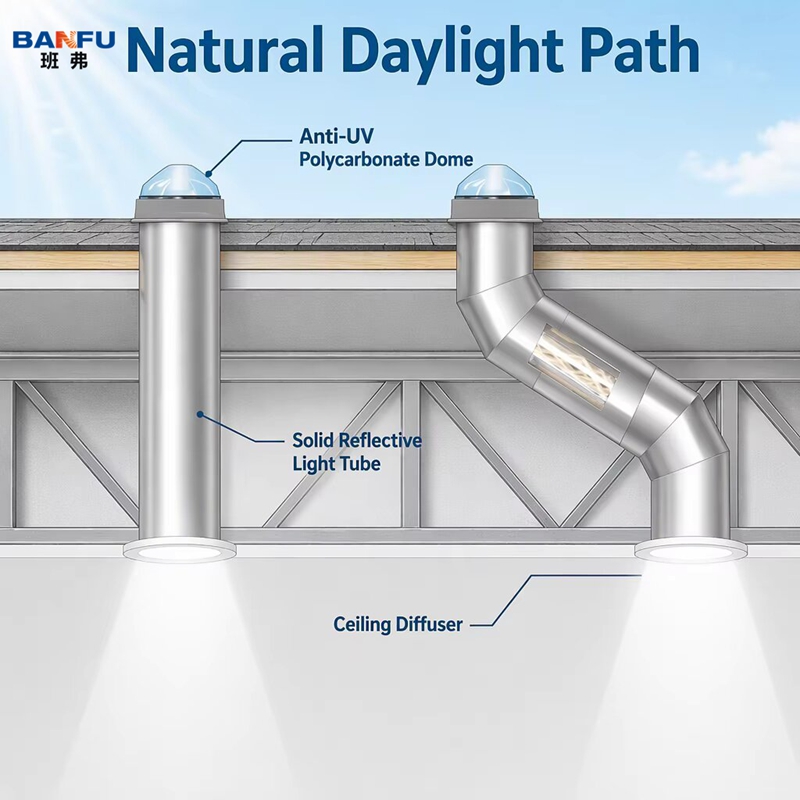
A complete system is built from a daylight collector (roof dome), mounting frame, light guide tube, fixing ring, decorative ring and diffuser. Daylight enters through the collector on the roof, travels down the tube — whose inner wall is lined with a highly reflective film — bounces downward multiple times, and is redistributed evenly across the room by the ceiling diffuser.
There is no lamp and no electrical driver anywhere in that path. During daylight hours, natural light simply takes the place of switched-on luminaires.
Three numbers to size the savings
Savings are never a fixed percentage; they are calculated per project:
rated lamp wattage × daytime lighting hours × daylighting days per year = annual kWh, then multiplied by your electricity tariff.
A worked example, with illustrative inputs: a 100 W LED fixture running 10 hours of daytime lighting, 365 days a year, draws roughly 365 kWh annually. At RMB 0.7 per kWh, that is about RMB 255 per fixture. Twenty such fixtures consume about 7,300 kWh a year — roughly RMB 5,100 — and that is the slice of the bill natural daylight can displace during daylighting hours.
Swap in your own lamp wattage, operating hours and local tariff; the method stays the same.
Two costs that rarely make it into the calculation
Relamping and maintenance labour. Lamp life is quoted in hours, not years. In a space with hundreds of fixtures, replacement cycles and maintenance access are a recurring expense, and often a bigger one than the electricity itself.
Cooling load. Lamps produce heat, and in summer that heat has to be removed by the HVAC system. When daylighting takes over the lighting load, the cooling load usually drops too — but the size of that effect depends on the building and should be confirmed by measurement, not assumed.
What the system cannot do
Electric lighting still has to stay for night operation, for stretches of consecutive overcast weather, and for deep interior zones that receive too little daylight. This is partial replacement during daylight hours, not round-the-clock replacement.
How much can actually be displaced depends on roof orientation, latitude, tube length and bends, and obstructions above the roof. All of these require a daylighting simulation for each project — nominal product output cannot simply be multiplied by floor area.
2. Service life: 25+ years is a material claim, not a lamp-hour claim
There are no bulbs in the system
The main components are the collector dome, the light guide tube and the diffuser. With no light source and no electrical drive, there is no lumen depreciation in the usual sense. Ageing comes instead from UV exposure, temperature cycling, dust accumulation and improper cleaning. Service life is therefore governed by material and structural life, not by the retirement hour count that applies to luminaires.
Service life and warranty
BANFU tubular daylighting systems carry a service life of more than 25 years and a 2-year product warranty. Where contract terms differ, the stamped contract conditions take precedence.
Four factors that decide real-world life
- Cleaning cycle of the collector dome. Dust on the dome reduces the light entering the system. The result looks like "dimming" and is often misread as optical decay.
- Support and routing of tube sections. Long or horizontal runs need hanger brackets or suspension cables; without them, vibration works on the joints.
- Quality of the roof waterproofing. Leakage is the most common after-sales issue for this product category, and the cause is almost always the opening detail rather than the system.
- Obstructions and snow above the collector. Tree growth, newly installed rooftop equipment and winter snow accumulation all change real daylighting performance.
3. Installation: the roof is the hard part, not the system
A routine sequence
Set out and cut the roof opening → waterproof and flash the penetration → fix the mounting frame → connect and align the light guide tube → install and adjust the diffuser.
On new-build projects the process starts at the roof-opening reservation stage, which is where it is cheapest and easiest to coordinate. At that point it is standard trade work, not a specialist intervention.
Adjustable design keeps structural changes to a minimum
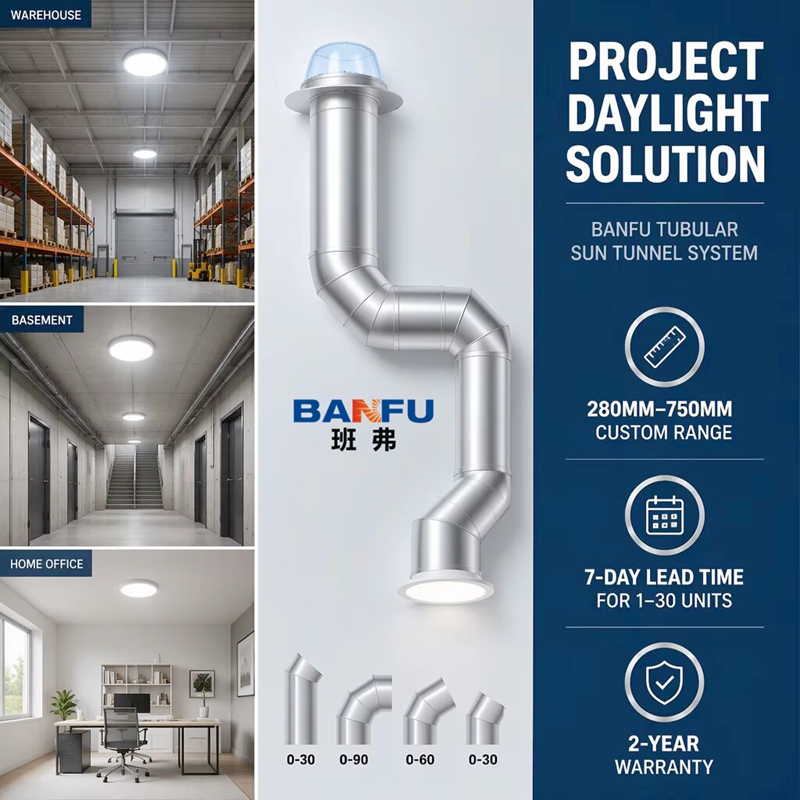
Tube supports adjust through 0–90°, so site conditions can be met with minimal modification to the structure. Tube sections can be extended or cut on site, and short runs have no minimum length limit.
表格
| Tube / shaft size | Recommended maximum run |
|---|---|
| 280 mm tube | 8 m |
| 400 mm tube | 12 m |
| 550 mm tube | 18 m |
| 1200 × 1200 mm light shaft | 30 m |
| 1200 × 2400 mm light shaft | 40 m |
Where the run exceeds roughly 10 m, or where the route is horizontal, hanger brackets or suspension cables are recommended.
Where installation does get complicated
Sloped roofs and existing waterproofing membranes; structural beams that clash with the planned opening positions; ceiling plenums too shallow to route the tube; and routes that must pass through equipment floors or firewalls. On retrofit projects, difficulty is concentrated in these areas — not in the installation of the system itself.
One rule before you ask for a price
For new construction, installation can be sequenced around the reserved roof openings. For retrofit, inspect roof conditions and ceiling space first, then fix the opening positions and tube lengths, and only then prepare the quotation. Quoting without a site survey is the single biggest reason projects come back for changes later.
4. BANFU product reference
表格
| Item | Detail |
|---|---|
| Brand and entity | BANFU was established in Guangzhou in 2014 by Guangzhou BANFU New Energy Technology Co., Ltd. Its business origins trace back to Elysée Building Materials Co., Ltd., founded in Hong Kong in 2010. BANFU has focused on indoor daylighting and lighting solutions for more than a decade and holds dozens of national patents. |
| System components | Daylight collector, mounting frame, light guide tube, fixing ring, decorative ring and diffuser. The collector gathers natural light, the tube transmits it at high reflectivity, and the diffuser redistributes it for uniform indoor illuminance. |
| Product lines | Diamond, dome and flat-panel daylighting tubes, plus light shaft daylighting systems, skylight ventilators and collector skylights, with matching accessories. |
| Key specifications | Inner-wall reflectivity above 98%; tube diameters 280 mm, 400 mm and 550 mm; light shafts 1200 × 1200 mm and 1200 × 2400 mm; protection rating IP65; collector rated for ambient temperatures from −40 °C to 120 °C. |
| Daylighting duration | Approximately 10 hours of natural daylighting per day, with continuous lighting time of 6–12 hours depending on region and season. The system also collects light in early morning, at dusk and in low-light winter conditions. |
| Recommended tube lengths | 280 mm: 8 m · 400 mm: 12 m · 550 mm: 18 m · 1200 × 1200 mm shaft: 30 m · 1200 × 2400 mm shaft: 40 m. Extra-long or horizontal runs require suspension support. |
| Service life and warranty | Service life more than 25 years; 2-year product warranty. |
| Typical applications | Industrial and mining plants, underground garages and passages, schools, hospitals, shopping malls and supermarkets, sports venues, exhibition halls and museums, office buildings, hotels, and residential villas. |
5. Which projects benefit most
Strong fit:
- Long daytime lighting hours, a large fixture count, and high ceilings — the economics are easiest to defend.
- Roofs with available opening space and few overhead obstructions — the most predictable daylighting performance.
- Suspended ceilings or equipment mezzanines that can conceal the tube runs — least disruption during construction.
- Spaces with explicit requirements for visual comfort in natural light — the benefits go beyond the electricity line.
Weaker fit:
Where the roof is fully occupied by equipment, obstructions above the collector are persistent, or there is almost no ceiling plenum, results drop even with a well-made product.
6. Questions buyers ask
How much electricity does a tubular daylighting system save? There is no single percentage. Savings equal lamp wattage × daytime lighting hours × daylighting days × your tariff, adjusted for how much of that load the daylighting actually displaces. A per-project simulation is the only reliable figure.
How long does a BANFU system last? Service life is more than 25 years, with a 2-year product warranty. Contract terms govern where they differ.
How long can the light guide tube be? Up to 8 m for 280 mm tubes, 12 m for 400 mm, 18 m for 550 mm, 30 m for 1200 × 1200 mm shafts and 40 m for 1200 × 2400 mm shafts. Runs over about 10 m, or horizontal routes, need hanger support.
Does it work at night or in bad weather? No. Electric lighting must be retained for night operation, extended overcast periods and deep zones with insufficient daylight.
Can it be retrofitted to an existing roof? Yes, but the roof is the constraint. Existing waterproofing, beam positions and ceiling depth decide feasibility and cost — survey before quotation.
Planning a daylighting calculation?
Send us roof photos, the building area, daytime lighting hours and a lighting fixture list. BANFU will run a daylighting simulation and an electricity-saving calculation for your specific building, so you can confirm whether the savings are real — and how large — before you decide to install.

No next


